Once again I’ve lagged in my posting here. The combination of stuff going on in my life and in the world hasn’t given me much motivation for blogging. Fortunately, my mood has changed and I am proud to present you with another Fossil Friday post.
For this month, I have decided to share some dinosaur tracks from the Glen Rose Formation at Dinosaur Valley State Park in Glen Rose, Texas. The tracks date back to the Early Cretaceous Period, and were made by theropods and sauropods. Figuring out what species made particular tracks is notoriously difficult, if not impossible, but there are some reasonable candidates. The theropod tracks were likely made by Acrocanthosaurus, while the sauropod prints may have been made by Sauroposeidon. Both genera are known from skeletal material in the area of about the same age as the footprints. Alas, we will never know for sure.
If you look up information on the Glen Rose tracks, you may come across claims that human footprints have been found there. These claims have long been debunked, with most of the alleged man tracks turning out to be theropod metatarsal prints, while the rest are indistinct depressions in the rock, erosional features, and a few outright forgeries. For more information on this subject, I highly recommend Glen Kuban’s excellent website.
As a paleontologist in the making, I of course love to read various nonfiction sources about my chosen field, whether they are books, scientific papers, popular articles, etc. However, I also enjoy exploring paleontology in the fictional realm. So to pay tribute to this aspect of my literary taste, I have decided to list five of my favorite paleontology-themed novels, in order of publication.
The Lost Worldby Sir Arthur Conan Doyle(1912)
Though best known for creating the character of Sherlock Holmes, Sir Arthur Conan Doyle also wrote this classic adventure story. In it, a group of explorers, led by the eccentric and ill-tempered Professor Challenger, travel to a plateau in South America where dinosaurs and other prehistoric animals continue to roam. While it starts off slow (as many older books do) by the time they reach the titular lost world it becomes a gripping adventure full of gloriously dated depictions of some of the most famous creatures of old that were known at the time. It’s safe to say that this book paved the way for future paleofiction, and that alone makes it a must-read.
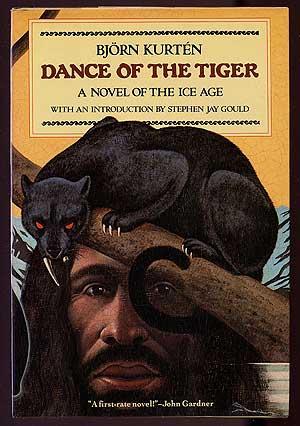
Dance of the Tiger by Björn Kurtén (1978)
This book is a little different from the others on the list in that it has a clear Cenozoic focus, being set during the Pleistocene. It centers around a young man named Tiger, whose tribe is massacred by a band led by a half-Neanderthal named Shelk. After being taken in by a tribe of Neanderthals, Tiger plans his revenge on Shelk. The author, Björn Kurtén, was a renowned Finnish paleontologist who specialized in Pleistocene mammals, and he incorporated this vast knowledge into his story. Many of the classic Ice Age mammals of Europe make appearances, with details of their depictions drawn from the science of the time, which is helpfully explained in an afterword. In addition to the scientific accuracy, Kurtén did not neglect to also give the book a rich cast of characters and compelling narrative, making this quite possibly the best story ever set in the Ice Age.
Jurassic Park by Michael Crichton (1990)
Yeah, you knew this book was going to be on the list. It’s hard to find anything to say about it that hasn’t already been said. While best known for spawning a hugely successful movie franchise, Jurassic Park is still worth reading on its own merits. While not the first novel to incorporate the ideas of the Dinosaur Renaissance, it certainly brought them to a much wider audience. The book features a greater variety of dinosaurs than the movie, many of which did not have many significant pop culture appearances before. I strongly suspect that many, if not most, of my readers have already read this book, but if you haven’t, definitely check it out.
Raptor Redby Robert T. Bakker (1995)
This is easily my favorite paleontological novel of all time. Of course, the author needs no introduction. A maverick and often controversial paleontologist, Bakker is known for his provocative ideas, many of which find their way into the narrative of this book. The story follows a year in the life of a female Utahraptor (the titular Raptor Red) after she loses her mate in a hunting accident. What follows is a series of events showcasing the world of Early Cretaceous North America as Raptor Red reunites with her sister and tries to find a new mate. Bakker does an excellent job of translating the protagonist’s thoughts while avoiding excessive anthropomorphism. While most of the majority of the book is of course focused on Utahraptor, several chapters shift to the perspectives of other animals, providing a myriad of views of this ancient world. With no human characters, the book is able to focus entirely on its prehistoric cast. I think that is why this book is my favorite. No human drama. Just dinosaurs being dinosaurs.
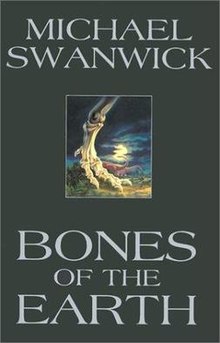
Bones of the Earthby Michael Swanwick(2002)
And now we reach the final book on my list. This is the only one to use the time travel trope, and it handles it in a most interesting way. The story involves humans being given the gift of time travel by mysterious beings from the future, which is used to explore the Mesozoic Era. However, fanatical terrorists are attempting to sabotage this project, which they see as a threat to their beliefs. Being a time travel story, the plot can get a little confusing at times, but it remains compelling enough that this is only a minor issue that can be remedied by a second reading. While there is a strong human component to this book, there are still more than enough dinosaurs and other prehistoric creatures to satisfy paleontology fans. Also of note is that discussions of various paleontological concepts are weaved within the narrative. If your looking for a good time travel novel with dinosaurs, I highly recommend this one.
Well, that’s my list. If you’re looking for some good reading, I hope I’ve given you some inspiration. Of course, there are many other books I could have included here, but these are my absolute favorites. I apologize if one of your favorites didn’t make the list, but I hope you still enjoyed it regardless.
It’s been a while, but I finally have another Fossil Friday post for you! For this month, I am sharing the material of an ankylosaur at the Texas Through Time museum in Hillsboro, Texas. The material was found in the Aguja Formation in west Texas, and appears to have affinities with the ankylosaur genera Nodocephalosaurus and Akainacephalus from New Mexico and Utah respectively. Indeed, the museum uses the restorations of Akainacephalus to give visitors an idea of what this animal might have looked like, with the highlighted areas representing the known remains of this Texas taxon. The Late Cretaceous dinosaur record of Texas is less well known than those of other states, so it’s always nice to see more fossils filling in those gaps.
This is the first post in what I hope will be an ongoing series showcasing some of the amazing fossils I encounter on my various adventures. While I don’t have the time or pictures to make this a weekly feature, I will try to at least get a post in on the first friday of each month.
For the first post in this series, I want to share King James the Eryops at the Whiteside Museum of Natural History in Seymour, Texas. King James is a real monster of a specimen, the largest Eryops in the museum’s collections. Unfortunately, I don’t know his exact measurements, and I didn’t get a picture with a good reference, but if you compare him to the other Eryops specimens on display, the size difference is quite noticeable.
Apart from his size, what makes King James especially interesting is his preservation. If you look closely at his skull, you’ll notice that some of the vertebrae are lying across the snout. This indicates that at some point after his death, part of his spine was displaced and dropped on top of his head. This is a good example of taphonomy, or the processes of decay and fossilization. Indeed, the museum has a very good sign explaining this aspect to visitors. This is just one of the many paleontological treasures at the Whiteside, and I intend to write a post shortly describing the goings on at this museum and my own involvement there. Keep your eyes out for it!
Greetings people of the paleontology community. It has been a long time since I’ve blogged, and I have decided to get a fresh start. You may be wondering why I have chosen to start a new blog instead of continuing with my old one. The reason is that there have recently been a lot of changes in my life which have revitalized my passion for paleontology, and I want to start anew to reflect this new enthusiasm. The biggest of these changes was getting a job as a science teacher, which has led to a greater interest in science education overall. I view this blog partially as a way to inform people beyond the classroom. In addition to education, there will be a major personal component to this blog as I will work to better document my experiences as I continue to work towards my dream. I hope you are excited, because I sure am!






 The Ancient Life Diaries